mercoledì 29 ottobre 2008

Solo a te!


Solo a te!

Sì, dedicata solo a te,
la torcia che illumina
quando all'improvviso
la luce se ne va.
Solo a te che riesci
a riparare il piatto
che si rompe di continuo.
Tu che daì così tanto
e ricevi così poco,
condannata all'ergastolo
nelle mani di un senz'anima.
Dedicata a te che
tra le tante scelte migliori
decidi di perire con me.
Tu che tra oro e diamante
avrai solo l'eterna gratitudine
del mio povero cuore!


Blessing Sunday Osuchukwu

lunedì 27 ottobre 2008

Troppa civiltà che diventa incivile...


Sì, so benissimo che non è una post adatta per questo periodo di pioggia e alluvione, ma mi dovete credere che non ce la facevo proprio più. Chi vede le foto penserà sicuramente che si tratta del mio solito apello per cercare di sensibilizzare la gente circa le situazioni disumane in Africa, beh questa volta non è esattamente così in quanto si tratterebbe della nostra cara Italia. Ogni volta che vado alla mia ambasciata, e ci vado spesso per lavoro, inevitabilmente mi trovo sempre a sopportare il disaggio che provo vedendo questa fontana, a 150m, che continuamente spreca una cosa preziosa che molte persone nel mondo cercano disperatamente, anche in Italia. Spesso, ho visto dei documentari, come nella foto, che raccontano le difficoltà di molti cittadini italiani, specialmente nel meridione, ad avere acceso all'acqua potabile. Infatti, molti di loro dovranno addirittura utilizzare acqua minerale per poter fare il bucato o per il WC mentre a Roma, e sicuramente in molte altre città d'Italia, si vedono sprecare questo bene che, giorno dopo giorno, diventa sempre più caro è più scarsa. Dove vivo ora, sento delle persone che hanno difficoltà a pagare la bolletta d'acqua.
Ho sentito anche molte volte raccontare della siccità che ormai è molto frequente nel nord Italia, chi non si ricorda il Po che spesso diventa asciutto a scapito dei numerosi agricoltori che dipendono da esso. Non voglio neanche toccare la questione dei paesi poveri che approfitterebbero, direttamente o indirettamente, dall'eventuale intelligenza nell'utilizzo d'acqua in occidente - a pensare che ci vorrebbe solo un semplice rubinetto per risparmiare tanta acqua, tanti soldi, tanta ecologia e ambiente, tante sofferenze e soprattuto la tanta rabbia in me!

Blessing Sunday Osuchukwu

sabato 25 ottobre 2008

Living in Italy: simple rules, regulations and advises.... (part 2)


Housing

Housing is definitely one of the major and initial problems a foreigner encounters in Italy. In the recent years, to find a house for rent has become a tug-of-war, not only because of the increase in demand but also for the exaggerated prices demanded by the landlords, which becomes even more if the apartment passes through an agency. The agencies normally charges more or less an equivalent of one month of the rent for their commission.
It is, however, advisable for anyone working regularly, that is with “busta paga”, to verify with his Bank or with a trustworthy financial Agency to know if he is ripe or entitled to purchase a house of his own. It is always better to purchase a house, hence the difference to pay for the mortgage is just a little higher than the normal amount for rent. Certainly, one has to be well informed about the tax-rate and if the rate is variable or constant through the years of the mortgage.
For a house on rent: it is very vital that there is a valid contract between the two parties. One has to go through the contract carefully to make sure that the stipulated points are in harmony with the official regulations and that it is not particularly penalizing to him. Another important issue is to make sure that the contract is registered with the authorities (“Agenzie delle entrate” - the same as - “Guardia di Finanza”), and the fee for the registration is normally divided in two equal parts. Such contract, which should be for four years, is also to be registered every year. A registered contract enables one to make up his necessary documents, for example; resident permit; family reunion, etc. and could also be necessary for an eventual remboursement of some part of the rent from the local council.
Legally, it is forbidden to sub-rent a house, even though any landlord knows how impossible it is for only one person to pay entirely for the rent, and so, the presence of another person has always been tolerated by the landlords, as long as there is peace in the house.
It is also very important to register any visitor or another person sharing the house together, whose name is not in the contract, with the Police within 5 days of arrival and obtain the so-called “cessione fabbricato”, failure to do so is against the law. In some houses (condominial), some amenities (lift, heating, etc.) are used in common with the others and so the fees are also shared among all, normally according to the sizes of the apartments.

To be continued.......

Blessing Sunday Osuchukwu

PS: è una post per sensibilizzare la mia gente ed altri stranieri, quindi chiedo umilmente scusa ai miei amici che non capiscono l'inglese.

giovedì 23 ottobre 2008

Essere in prigione, spesso, non vuol dire essere dietro le sbarre...


Prigione

Vivere una sola vita
in una sola città
in un solo paese
in un solo universo
vivere in un solo mondo
è prigione

Amare un solo amico
un solo padre
una sola madre
una sola famiglia
amare una sola persona
è prigione

Conoscere una sola lingua
un solo lavoro
un solo costume
una sola civiltà
conoscere una sola logica
è prigione

Avere un solo corpo
un solo pensiero
una sola conoscenza
una sola essenza
avere un solo essere
é prigione


Poesia dal Kenia (N.Ngama)

martedì 21 ottobre 2008

No al razzismo e segregazione nelle scuole italiane


Ho il dovere di denunciare lo sgomento che provo ultimamente nel seguire i numerosi dibattiti sulla segregazione nelle scuole di alunni stranieri da quelli italiani, e la sua approvazione parlamentare fa molto riflettere. Poco tempo fa, c'erano solo tre settori in cui si potevano fare e dire tutto tranne a pensare al razzismo o altri sentimenti simili: sport, musica e scuola. E poi, i primi due sono stati anche essi inquinati, forse prevedibile nel momento in cui ad esserne protagonisti assoluti sono gli adulti, adulti incoscienti, ignoranti e spesso utilizzati dagli altri per motivi politici ed egoistici. Ma mai avrei pensato che si sarebbe arrivata alla scuola, al punto di utilizzare i bambini innocenti per cercare di ottenere quello che oggi sembra di essere i veri obbiettivi di alcuni politici, cioè la segregazione, il separatismo, l'apartheid e il razzismo. E quello che mi stupisce molto in questi dibattiti è che non sono né gli alunni italiani né gli insegnati a volere questa odiosa politica scolastica, bensì qualche politico che dice di difendere “la cultura italiana”. In questi giorni ho pensato a come abbiamo sofferto lo stesso fenomeno in Africa, specialmente in Sud Africa, e alle conseguenze subite, ho pensato a come molti di noi avevano sognato e sperato di apprendere nelle scuole italiane ciò che è necessario per aiutare i nostri paesi a crescere e come, non essendo possibile per molti di noi, queste speranze sono state affidate ormai ai nostri figli. E poi ho pensato e finalmente posso dire ora di aver trovato la risposta a perché una ragazzina marocchina, qualche giorno fa, è stata picchiata da altri ragazzini perché “occupava un posto sull'autobus non essendo italiana”, sì, perché ci sono delle persone autorevoli più grandi che li incitano e ch li ispirano. E, inevitabilmente, ho pensato anche a come questo fenomeno di sedere sull'autobus è stata combattuta negli USA circa 50 anni fa, cavolo, ma allora qui, o si sta mezzo secolo indietro, o qualche individuo ci vuole riportare indietro di 50 anni.
Beh, sapete bene che non vi potevo lasciar andare via senza svelarvi il pensiero di un bambino straniero che si trova in Italia di oggi.....

Chi altro da sacrificare?

Mio padre ed altri parenti miei hanno smesso di vivere, combatendo per quella che poi hanno chiamato la nostra indipendenza.

Per farmi diventare un cittadino del mio paese, Nelson Mandela ha sacrificato circa 28 anni della sua vita.

Martin Luther King ha versato il suo sangue per far capire al mondo che anche io sono un essere umano come gli altri.

Molti signori sotto la bandiera dell'ONU hanno preferito morire al posto mio in tutti questi lunghissimi anni di guerre civili per farmi vivere.

Per portarmi un po' di pace e un mondo senza violenza, Mahatma Ghandi ha dovuto morire.

Madre Teresa di Calcutta ha vissuto la sua vita sulle strade per cercare di rispondere a tutte le mie esigenze.

Ora, per potermi sedere accanto al mio compagno di scuola italiano, mi dovete dire chi altro sacrificare, visto che non basta più in quanto essere umano.

Blessing Sunday Osuchukwu

domenica 19 ottobre 2008

Grazie mille per la vostra presenza alla giornata ecologica, decoro urbano e ambientali di oggi

Alcune immagini e video clip della manifestazione..........


giovedì 16 ottobre 2008

Oggi è la Giornata Mondiale dell'Alimentazione....

Per non dimenticare chiunque in qualsiasi parte del mondo soffre per la mancanza di cibo e d'acqua...


Non dimenticherò

Mentre sto per fare questo viaggio di ritorno, molto anticipato e non voluto da me, verso il cielo, ti giuro che non dimenticherò:

Non dimenticherò che i denti che ho cresciuto per masticare non hanno avuto niente da mangiare per giorni, settimane, mesi.....

Non dimenticherò che le uniche cose che il mondo mi ha potuto assicurare nella vita sono la fame, la sete, le guerre e le epidemie.

Non dimenticherò che nonostante la terra sia piena di grattacieli ed altri edifici di ogni genere, gli unici posti che ho trovato per dormire sono delle grotte e dei sotto ponti.

Non dimenticherò di non essere stato mai vaccinato, di non aver mai avuto i medicinali per curarmi e di essere stato convinto da te che il diritto alla vita dipende dalla provenienza geografica, la razza e la religione.

Non dimenticherò che hai direttamente o indirettamente partecipato a tutti i mali che hanno portato allo spegnimento precoce della mia miserabile vita.

E tu che hai fatto di tutto per cercare di salvare la mia vita senza neanche conoscermi, devi sapere che anche se non ce l'ho fatta, molti altri bambini che stanno lottando tra la vita e la morte potrebbero farcela, grazie a te. E io non dimenticherò.

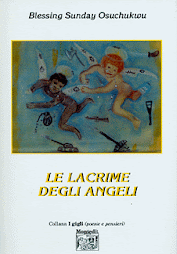
Blessing Sunday Osuchukwu (le lacrime degli angeli)

lunedì 13 ottobre 2008

Giornata Ecologico e del Decoro Urbano.....

Comune di Roma - Dipartimento X - Nucleo Decoro Urbano e Ambientale


Associazione di Volontariato "Bless Children's Foundation"


con altre associazioni presentano


Giornata Ecologica, Decoro urbano e Ambientale
Domenica 19 Ottobre 2008 (dalle 10:00-16)
Parco di Spinaceto - Roma - Entrata: via Carlo

Eventi: Diverse attività ambientali e sociali; Raccolta differenziata, Orienteering nel parco; musica etnica; laboratorio di riciclaggio creativo, Giochi per i bimbi, Consigli utili sul risparmio energetico, Eco quiz, Mostra micologica, Dimostrazione di primo soccorso, ecc.
Per una Domenica divertente - Portate anche i vostri bambini!
( Alle ore 13:30 pranzo biologico gratuito)

Siete tutti invitati !!!


Per informazione: Email: blesschildren@yahoo.it Cell. 339-6404614
Blessing Sunday Osuchukwu (Presidente, Bless Children's Foundation)


sabato 11 ottobre 2008

Gli ultimi arrivati nella grande famiglia......

Amici, vorrei condividere queste rare emozioni con voi, sono arrivati tra di noi, in Africa, due cuccioli di leoni bianchi.... e stiamo festeggiando!


Il tabloid britannico Daily Mail ha riportato le immagini, colte da un fotografo dilettante, di due leoni bianchi nati in Sudafrica. Un evento rarissimo che, secondo la leggenda, si verificherebbe una volta ogni 100 anni. I leoni bianchi, proprio per il loro splendido mantello, sono stati cacciati fino a provocarne la quasi estinzione. Ma per la loro rarità e stranezza spesso sono attaccati dagli stessi leoni. Il fortunato testimone di un simile evento è Jim Moir, un pilota dell'aeronautica in pensione, originario del Glouchestershire. Nel corso di un safari in una regione nascosta del Sudafrica. "Quando li ho visti - ha raccontato - sono quasi caduto per la sorpresa". Il luogo in cui i cuccioli di tre settimane ("battezzati" dal fotografo Castore e Polluce) sono nati si trova nella riserva di Timbavati, che costeggia il Kruger National Park. Diversamente da quanto si potrebbe credere, i leoni bianchi non sono albini: hanno gli stessi occhi degli altri membri della specie, ma il gene regressivo di cui sono portatori fa perdere nella loro pelle e nel pelo la normale pigmentazione. Secondo le tribù africane questi animali sarebbero messaggeri di Dio e il loro pelo bianco rappresenterebbe la purezza che regna in tutte le creature.

giovedì 9 ottobre 2008

Quando la distanza divide....

Quando la distanza divide.....


Due teste, due corpi e due anime
amalgamati in cielo
e accoppiati sulla terra.
Momenti magici
trascorsi insieme ad amare,
dare, prendere, ridare e riprendere.
Sogni e progetti nel cassetto
aspettando i momenti giusti
per completare un ciclo.
E poi
arrivi tu come un fulmine
a mettere zizzania,
a fissare punti interrogativi.
Ma chi sei tu per ridisegnare
la mappa dei nostri destini?
Un amore testato e collaudato
sopravvissuto alle quattro stagioni
non merita tale fine.
No, questa volta non puoi vincere,
perché i nostri patti valgono molto più
di pochi centinai di chilometri!

Blessing Sunday Osuchukwu

martedì 7 ottobre 2008

Living in Italy: simple things to know........


Transportation

Public transportaion: in Italy, the public transportation is considerably cheap and affordable considered to other western European countries. It's efficiency is frequently criticized, but one can say that it has been an efficient substitute to private means of transportaion.
Tickets must be bought in advance before boarding, unless in some of those buses and trains where tickets could also be bought on board from the available automatic machines or from the conductors. Beware, it is not just enough to have the ticket with you but the ticket must be cancelled or stamped in the appropriate automatic machines to render it valid for the journey. The machines are normally situated inside the train stations, in front of the railways, inside the metro stations, inside the buses, etc. The passenger should comunicate to the driver of the bus or to the assistant (conductor) of the train when the machine is not in order, this officer should validate the ticket with an ordinary pen. Travelling without tickets or cancelled tickets are against the laws and regulations and are punishable by reasonable fines. However, who is caught by a controller without a ticket and without the money to pay for the fine, has the right to give his personal data for the fine to be sent to him at home. Any refusal to do that could make the controller to seek for the intervention of the Police, which is absolutely not advisable. Normally, there are instructions on the tickets on how to use them and for eventual reimbursement when the tickets are not used or when the journey is cancelled or too much delayed.

Private transportaion: Who desires to own a vehicle in Italy should, first of all, obtain a driving-licence for such vehicle. Some country's driving licences could simply be translated and authenticated at the appropriate offices to render them valid, one has to be informed if his country has this bilateral agreement with Italy. Who buys a vehicle gets a certificate of ownership (cambio di proprietà) with which, together with the vehicle papers, the vehicle is insured. The government tax “bollo” is paid yearly and the amount depends on the capacity of the vehicle. Driving a vehicle in Italy without a driving licence or insurance could lead to an immediate seisure of that vehicle, and a very high fine to pay.
Many cities, fighting against polution, have restrictions on private vehicles from entering their historic centers, so one has to be informed about his own city.

Blessing Sunday Osuchukwu


Living in Italy: simple rules and regulations (part 2)


Housing

Housing is definitely one of the major and initial problems a foreigner encounters in Italy. In the recent years, to find a house for rent has become a tug-of-war, not only because of the increase in demand but also for the exaggerated prices demanded by the landlords, which becomes even more if the apartment passes through an agency. The agencies normally charges more or less an equivalent of one month of the rent for their commission.
It is, however, advisable for anyone working regularly, that is with “busta paga”, to verify with his Bank or with a trustworthy financial Agency to know if he is ripe or entitled to purchase a house of his own. It is always better to purchase a house, hence the difference to pay for the mortgage is just a little higher than the normal amount for rent. Certainly, one has to be well informed about the tax-rate and if the rate is variable or constant through the years of the mortgage.
For a house on rent: it is very vital that there is a valid contract between the two parties. One has to go through the contract carefully to make sure that the stipulated points are in harmony with the official regulations and that it is not particularly penalizing to him. Another important issue is to make sure that the contract is registered with the authorities (“Agenzie delle entrate” - the same as - “Guardia di Finanza”), and the fee for the registration is normally divided in two equal parts. Such contract, which should be for four years, is also to be registered every year. A registered contract enables one to make up his necessary documents, for example; resident permit; family reunion, etc. and could also be necessary for an eventual remboursement of some part of the rent from the local council.
Legally, it is forbidden to sub-rent a house, even though any landlord knows how impossible it is for only one person to pay entirely for the rent, and so, the presence of another person has always been tolerated by the landlords, as long as there is peace in the house.
It is also very important to register any visitor or another person sharing the house together, whose name is not in the contract, with the Police within 5 days of arrival and obtain the so-called “cessione fabbricato”, failure to do so is against the law. In some houses (condominial), some amenities (lift, heating, etc.) are used in common with the others and so the fees are also shared among all, normally according to the sizes of the apartments.

To be continued.......

Blessing Sunday Osuchukwu

The Italian School System

What you Need to Know

The Italian school system is offered free to all children in Italy regardless of nationality. All children are required to attend school from age six through sixteen with the compulsory age limit being raised over the next couple years. Even the public nursery schools are free with reasonable sized classes and motivated teachers. The school system has a good reputation but tends to focus on rote memorization and obedience over creativity.
"Scuola elementare", or primary school, begins at age six and continues for five years. Class sizes generally run about twenty five children per class with a minimum of ten students. "Pluriclassi", or mixed-level classes, have between six and twelve students. Schooling and textbooks are free. Municipalities manage transportation and school meals, most often asking for contributions but making exceptions for needy families. The curriculum includes: Italian, English, Geography, History, Math, Science, Technology, Music, Art, Physical Education, Information Technology and Catholicism.
The next level formerly known as "scuola media" is now known as "scuola secondaria di 1 grado", secondary school level one, where students study until they turn fourteen years old. Formerly at age fourteen, compulsory education was considered complete. This limit has been raised to sixteen and will continue to be raised in increments until the 2007/2008 school year. While the schooling is free, books must be purchased at the secondary level. Class size is about 21 students per class. The curriculum includes: religion, Italian, English, an alternate foreign language, history, geography, science, math, technology, information technology, art, music and physical education.
Students must take and pass an exam before moving up to "scuola secondaria superiore" or "liceo", higher secondary school. Higher secondary school lasts five years until the student is eighteen or nineteen years old. The higher secondary schools are voluntary. Students must make a choice about their education at an early age and choose the higher secondary school they will attend. Each higher secondary school is broken down by subject matter such as:

liceo scientifico (scientific)
liceo classico (classic)
liceo linguistico (language)
istituto magistrale (school for teachers)
istituto tecnico (technical school)
istituto professionale (professional school)

The art schools are further divided into:

liceo artistico (artistic high school)
istituto d'arte (art school)
accademia di danza (dance academy)
conservatorio di musica (conservatory of music)
accademia nazionale d'arte drammatica (national academy of dramatic arts). Once the student has chosen his or her field of study, they are rarely allowed to change their minds.
Class sizes are between twenty five to twenty eight students in higher secondary school. Higher secondary schools do charge tuition. However, based on family income, some students may qualify for exemptions or assistance. Curriculum varies depending on the course of study chosen.

After completing the higher secondary school, students must pass another exam in order to receive their "Diploma di Maturità". Once they have their diplomas, they either begin their careers in their professions or move on to the University.
Italy has forty two state universities, six private universities, three technical universities and twelve specialized university institutes. Each university offers four main courses: "diploma universitario" (university diploma), "Diploma di Laurea" (Bachelor of Arts/Science), "Dottorato di Ricerca" (research doctorate), and "Diploma di Specializzazione" (diploma of specialization).

(By Celeste Stewart)


Religeous freedom in Italy

Italy is a prevalently Roman Catholic country, with minorities of Muslims (mostly from recent immigration) and Jews. Christian Protestants are historically few, due to a history of intolerance that has continued until modern times. A few Protestants, such as two-time Prime Minister Sidney Sonnino, have distinguished themselves.
The 97.67% of Italians are baptized according to the rite of the Catholic Church. According to a survey of Eurispes 2006, 87.8% of the population declares itself Catholic and 36.8% practitioner. However a large percentage of Catholics do not necessarily support all the directions of the Church, as demonstrated by the referendum about divorce or abortion.
In Italy in 2006 there were 53 millions of Christians, 1,210,00 Muslims, 160,000 Buddhists, 115,000 Hinduists, 70,000 Sikhs, 45,000 Hebrews, 15,000 Pagans, and 4 millions of Atheists and Agnostics.
The Catholic Church holds considerable power and has an influence on most political parties, with the exceptions of the Italian Radicals and the Communist Refoundation Party.
Usage of Catholic symbolism (especially crosses) in courts and schools has been contested by minorities, but was ruled legal; many contend that it is in clear violation of the principles of religious freedom outlined in the Constitution of Italy. It is claimed that the Crucifixes and other Catholic symbols are not considered by the supreme court religious signs but cultural symbols.

Articles in the Constitution of Italy about freedom of religion
3: All citizens have equal social dignity and are equal before the law, without distinction of [...], religion, [...]
8: All religious confessions are equally free before the law.
19: All have the right to profess freely their own religious faith in whatever form [...], provided that the rites are not contrary to morality.

(From Wikipedia)


The Italian Political System

The politics of Italy take place in a framework of a parliamentary, democratic republic, and of a multi-party system. Executive power is exercised collectively by the Council of Ministers, which is led by a President, in jargon referred to as "premier", "primo ministro" or "prime minister" in English. Legislative power is vested in the two houses of parliament primarily, and secondarily on the Council of Ministers. The judiciary is independent of the executive and the legislative. Italy has been a democratic republic since 2 June 1946, when the monarchy was abolished by popular referendum. The constitution was promulgated on 1 January 1948.

Government

The 1948 Constitution of Italy established a bicameral legislature (parliament), an executive branch composed of a Council of Ministers (cabinet), headed by the President of the Council (prime minister), and an independent judicial branch headed by the 'Consiglio Superiore della Magistratura'.

Head of State


Giorgio Napolitano was elected President on 10 May 2006.
As the head of state, the President of the Republic represents the unity of the nation and has many of the duties previously given to the king of Italy. The president serves as a point of connection between the three branches of power: he is elected by the lawmakers, he appoints the executive, and is the president of the judiciary. The president is also the commander-in-chief of armed forces.
The President of the Republic is elected by an electoral college consisting of both houses of Parliament and 58 regional representatives for a seven-year term. His election needs a wide majority that is progressively reduced from two-thirds to one-half plus one of the votes as the ballots progress. The only Presidents ever to be elected on the first ballot are Francesco Cossiga and Carlo Azeglio Ciampi. Mr. Ciampi was replaced by Giorgio Napolitano, who was elected on 10 May 2006. While it is not forbidden by law, no president has ever served two terms.
Usually, the President tries to stay out of the political debate, and to be an institutional guarantee for all those involved in the political process. The president can also reject openly anti-constitutional laws by refusing to sign them, since he acts as the guardian of the Constitution of Italy.

Executive

The President of the Republic appoints the Council of Ministers and its President (the prime minister). The prime minister advises the President of the Republic on the composition of the rest of the Council of Ministers (the cabinet), which comprises the ministers in charge of the various governmental departments. In practice, the President accepts prime minister's advice, and submits the proposed Council for a vote of confidence from both parliamentary chambers.
The government has the power to issue decrees. Decrees have to be confirmed in the parliament, and "decree jam" has been a problem in recent years, as governments try to reform the structure of the state using chiefly decrees instead of passing laws directly through the parliament.
The prime minister, through the cabinet, effectively runs the government of Italy. The current Prime Minister is Silvio Berlusconi.

Legislative branch

Italy elects a parliament consisting of two houses, the Chamber of Deputies (Camera dei Deputati), which has 630 members and the Senate of the Republic (Senato della Repubblica), comprising 315 elected members and a small number of senators for life). As of 15 May 2006, there are seven life senators of whom three are former Presidents. Both houses are elected for a maximum of five years, but they may be dissolved before the expiration of their normal term.
Legislation may originate in either house and must be passed in identical form by a majority in each.

Judicial branch

The Italian judicial system is based on Roman law modified by the Napoleonic code and later statutes. It is based on a mix of the adverserial and inquisitorial civil law systems, although the adversarial system was adopted in the Appeal Courts in 1988. Appeals are treated almost as new trials, and three degrees of trial are present. The third is a legitimating trial.
There is only partial judicial review of legislation in the American sense. Judicial review exists under certain conditions in the Constitutional Court, or Corte Costituzionale, which can reject anti-constitutional laws after scrutiny.
The Constitutional Court is composed of 15 judges one of which is the President of the Italian Constitutional Court elected from the court itself. One third of the judges are appointed by the President of the Italian Republic, one-third are elected by Parliament and one-third are elected by the ordinary and administrative supreme courts. The Constitutional Court passes on the constitutionality of laws, and is a post-World War II innovation. Its powers, case load, and frequency of decisions are not as extensive as those of the U.S. Supreme Court.
Italy has not accepted compulsory jurisdiction of the International Court of Justice

Chamber of deputies: 630 members
Senate of the Republic: 350 members
All Italian citizens older than 18 can vote. However, to vote for the senate, the voter must be at least 25 or older.

There are 20 Regions in Italy:

Abruzzo (with capital L'Aquila)Basilicata (Potenza)Calabria (Catanzaro)Campania (Napoli)Emilia-Romagna (Bologna)Friuli-Venezia Giulia (Trieste)Lazio (Roma)Liguria (Genova)Lombardia (Milano)Marche (Ancona)Molise (Campobasso)Piemonte (Torino)Puglia (Bari)Sardegna (Cagliari)Sicilia (Palermo)Trentino-Alto Adige / Südtirol (Trento, Bolzano)Toscana (Firenze)Umbria (Perugia)Valle d'Aosta (Aosta)Veneto (Venezia)

Presently there are 110 Provinces and about 8101 local councils (Comune)

(Wikepedia, Blessing Sunday Osuchukwu)

domenica 5 ottobre 2008

Stop al razzismo.....


Razzismo: migliaia in corteo a Roma. In testa immigrati di Castel Volturno e Milano, anche cinesi(ANSA) - ROMA, 4 OTT - 'Stop al razzismo'. E' quanto scritto sullo striscione che ha aperto il corteo antirazzista partito da piazza della Repubblica a Roma. In testa al corteo un centinaio di immigrati di Castel Volturno, con in mano le foto dei sei ragazzi trucidati dalla Camorra. A seguire, gli immigrati di Milano, di recente teatro di violenze a sfondo razzista. Alla manifestazione stanno partecipando alcune migliaia di persone. Tanti africani, ma anche cinesi e italiani.


Perché respingermi?

Migliaia di chilometri fatti a piedi nudi, a stomaco vuoto,
Giorni e notti passati nel deserto con la gola asciutta,
Ore e ore di estate nascosto nel container senza ossigeno,
Perché respingermi?

Giornate intere passate nelle fonderie e campi agricoli,
Giornate intere passate a badare, e tra i piatti sporchi,
Mesi trascorsi sulle strade con il negozio sulle spalle,
Perché respingermi?

Chiedevo solo per un pezzo di pane, acqua potabile e coperta,
Chiedevo solo di essere lontano dalle guerre civili, dall'odio,
Chiedevo solo per un'altra giornata di sopravvivenza umana,
Perché respingermi?

Cercavo solo il Presente che non riesco più a trovare,
Cercavo solo una ragione per continuare a vivere,
Perché rovinare una speranza e impedire un respiro?
Perché respingermi?


Blessing Sunday Osuchukwu

venerdì 3 ottobre 2008

A proposito di Africa con la povertà, debiti, emigrazione......

Ieri, al programma “Annozero”, un sindaco della Lega di Verona, forse giustamente, disse che il problema dei paesi africani è che sono amministrati dai banditi, e poi s'è fermato lì come d'altronde fanno molti. Anche le vecchie generazioni africane avevano sempre utilizzato frasi del genere per giustificare le situazioni disastrose di molti paesi africani, senza andare oltre. Beh, devo dire al sindaco di Verona che le nuove generazioni africane sono diverse perché vanno oltre quella semplice frase per chiedere: “Ma dove sono i nostri soldi rubati dai “banditi africani?” E la risposta che loro trovano è che non si trovano in Africa, bensì in Europa e in America. Sì, signor sindaco, i centinai di miliardi di euro rubati dai “banditi” africani si trovano tuttora nelle banche svizzere, tedesche, inglesi, americane e qualcuno investito anche in Italia. Mentre i veri proprietari di quei soldi stanno ancora morendo di fame, ci sono questi paesi, cosiddetti civili, che accettano volentieri questi miliardi dai “banditi” pur sapendo che sono stati sottrati dagli affamati. In questi paesi, cosiddetti civili, esistono o non esistono delle leggi contro il riciclaggio del denaro sporco? O questi soldi rubati dai “banditi” diventano automaticamente puliti quando arrivano in Europa, o sono così fesi di non sapere che un politico africano che vuole depositare €10 miliardi nel proprio conto personale abbia rubato quei soldi? Molti di quei soldi sono poi abbandonati, dimenticati o quant'altro per vari motivi e signor sindaco dovrebbe sapere come e cosa si fanno con miliardi depositati nelle banche: no, non dormono lì ad aspettare i proprietari che magari non torneranno mai per riprenderli, ma vengono utilizzati per sviluppare quei paesi che ACCETTANO QUESTI SOLDI RUBATI. Caro sindaco dovrebbe sapere che chi deliberatamente accetta di continuo, e quindi incoraggia anche, le cose rubate è un criminale anche lui, e forse di più per l'incitamento che sicuramente non mancheranno. Non voglio credere che nel XXI secolo tali orribili ingiustizie degli stati cosiddetti civili, perché proprio di questo si tratta, debbano continuare ad esistere, e come se non bastasse, esce fuori un sindaco che pensa ancora che gli africani di oggi sono così scemi da non capire. Le nuove generazioni africane lo sanno ora e sono arrabbiate quando le vengono speso dette che la Svizzera è come il paradiso e il loro continente come l'inferno, forse loro non stanno più pregando per un pezzo di pane ma vogliono poter riprendere ciò che li appartiene di diritto, il modo potrebbe essere sbagliato ma almeno cominciano a farsi sentire, e non mi sorprenderò se arriverà quel giorno in cui loro o i loro figli chiederanno questi paesi di rimborsare i loro soldi rubati per anni, con i dovuti interessi maturati.
Parlando con alcuni ragazzi africani qualche giorno fa su questo argomento, uno di loro disse: “Quello che mi fa arrabbiare di più è che quando dicono di farci un favore, prestando qualche soldo ai nostri paesi con interesse molto elevato, vanno proprio a prendere un po' di quei nostri soldi rubati”......

Blessing Sunday Osuchukwu

mercoledì 1 ottobre 2008

Nigeria oggi, 1° Ottobre 2008, compie 48 anni e viene festeggiata a Westin Excelsior di Roma...


Mentre Le faccio i miei migliori auguri, vorrei tanto che rendesse conto di essere più che matura per poter rivalutare e gestire meglio le sue risorse naturali per sfamare i suoi cittadini, molti dei quali stanno morendo di fame e malattie banali. Di aprire un po' le sue orecchie per ascoltare le disperazioni delle sue piccole donne che non vogliono più essere oggetti di compravendita per poi finire sulle strade, per arricchire qualche schiavista senza scrupoli. Di accogliere e favorire gli appelli dei suoi numerosi “cervelli e mani” dispersi nel mondo che vorrebbero rientrare per aiutare la loro patria a crescere.
E devo dire che il nostro nuovo ambasciatore sta già lavorando seriamente per migliorare le cose.

Alcune immagini della festa:

L'ambasciatore di Nigeria (capello rosso) con alcuni ospiti


Abiti, antichi, tipicamente tradizionali della Nigeria (Benin)


Blessing con Cardinale Arinze alla festa


Donne in abiti tradizionali della Nigeria (Igbo)


Abiti tradizionali della Nigeria: uomini (Hausa), donna (yoruba)


Abiti tradizionali della Nigeria (yoruba)


Tantissimi auguri!!!

Blessing Sunday Osuchukwu